
An insight into Continuous Professional Development (CPD) for Primary Teachers in South Sudan
Written by Trustees, Richard Arden and Alistair Mack, during a field visit to Western Equatoria and Unity States in South Sudan, where they observed WTI's Primary School Continuous Professional Development (CPD) programmes in action.
There is little debate that teacher quality determines learning quality. The question in fragile contexts is not whether reform is needed — it is how to sequence and maintain this critical investment realistically.
Following a recent visit to Western Equatoria and Unity States in South Sudan, where we observed WTI-run Primary School Continuous Professional Development (CPD) programmes it was clear that CPD improves classroom practice and pupils receive a higher standard of education.
But unless it is embedded within a recognised qualification pathway, its long-term impact will remain limited.
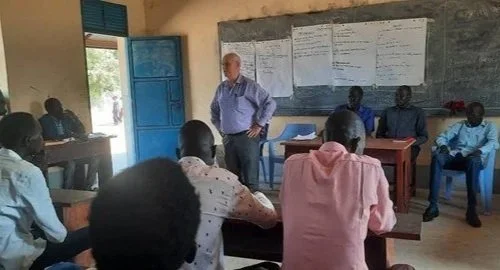
Pictured above: Richard Arden speaking to teachers in a classroom in Bentiu, Unity State, South Sudan
The evidence from classrooms
In schools where we observed lessons, the contrast between CPD-trained and untrained teachers was visible.
Teachers who had participated in CPD demonstrated stronger understanding of the new competency-based curriculum. They relied less on traditional rote repetition and more on structured questioning, group work and pupil engagement. Lesson plans were used more consistently, and both girls and boys participated actively.
Teachers themselves articulated the change with striking clarity. One said, “Before I went to class with the textbook. Now I go with a lesson plan.”
Another told us, “CPD changed my life.”
State-level education officials were equally clear in their assessment: investment in CPD was directly improving learning quality. There is broad acceptance of the need to improve teaching standards, learning materials, and teacher training to strengthen academic performance, particularly in foundational subjects such as English and Mathematics.
The structural constraint
However, improvement in classroom practice alone does not solve structural challenges.
South Sudan faces an estimated shortage of tens of thousands of qualified teachers. Out of the 46,782 primary school teachers, a staggering 53% are unqualified – with a stark lack of female teachers in classrooms. (EMIS, 2021). Salaries are inconsistent. Attrition is high, particularly where alternative employment is available.
In this context, we repeatedly heard anxiety from teachers about recognition and certification. They valued the training but questioned what it meant for their professional future.
If teachers improve their practice but receive no recognised qualification, no pathway to Qualified Teacher Status (QTS), and no formal acknowledgement from the Ministry, motivation will inevitably weaken. Retention will suffer. Reform will stall. It’s a vicious cycle undermining the quality of education available in South Sudan.
Short-term CPD without certification risks becoming a technical fix rather than systemic reform.
From workshops to pathways
The central lesson from our visit is that CPD must evolve from a training intervention into a structured professional pathway.
This means integrating:
Professional studies
Subject content mastery
Supervised classroom observation
Formal accreditation through recognised institutions
Only then does CPD become a ladder rather than a stepping stone.
In fragile systems, sequencing matters. Waiting for university-led diploma programmes alone to produce sufficient numbers of qualified teachers may take years. A pragmatic approach may include revisiting structured primary-level certification options alongside longer-term diploma expansion. Countries such as Kenya and Uganda only phased out primary certificate teachers relatively recently. Properly trained primary-level teachers are demonstrably better than untrained ones — and can progress to higher qualifications over time.

Pictured: Alistair Mack with teaching staff at a school in Yambio, Western Equatoria
The multiplier opportunity
Another observation from our visit is that CPD’s full system potential is not yet realised.
Teachers who complete CPD are not systematically mentoring untrained colleagues. Follow-up support is limited, and school-based professional communities remain underdeveloped.
With structured mentoring roles, modest incentives, and Ministry endorsement, CPD-trained teachers could act as in-school trainers — multiplying impact without multiplying cost in resource-constrained systems.
Evidence as influence
The relevance of these findings extends beyond South Sudan. When the Ministry of Education in Somaliland recently approached WTI for support to help teachers adapt to a new competency-based curriculum, WTI shared the South Sudan CPD findings.
As a result, the Ministry has requested technical dialogue with WTI and counterparts in South Sudan to explore locally grounded solutions. Evidence changed the conversation.
Implications for donors and partners
For development partners, three implications follow:
CPD is a high-impact intervention when well designed, monitored and bringing tangible benefits to teachers and pupils
Without recognised certification pathways, sustainability is compromised and the attrition rate will inevitably continue
Integrated models offer stronger long-term value for money than repeated short-term training cycles
Teacher reform in fragile contexts is not achieved through isolated workshops. It requires alignment between Ministries, academic awarding bodies, donors and delivery partners around structured progression routes.
The policy challenge is not whether to invest in CPD — it is how to embed it within national teacher qualification frameworks.
A moment of opportunity
Across the region, competency-based curricula are being introduced. This creates urgency but also opportunity.
If CPD can be aligned with certification, mentoring structures and scalable pathways, it can become a cornerstone of system reform rather than a supplementary activity.
The classrooms we visited show what is possible. The next step is ensuring that improvement is recognised, formalised and sustained.